Wall Putty Coverage & Thickness — How Much You Actually Need
Wall Putty Coverage and Thickness — How Much You Actually Need, why published figures range from 10 to 22, the right thickness for two coats, and how to…
It is half past three. The last bag is open, there is a wall and a half still to go, and the supplier shuts at six.
Here is the part that turns a small problem into an expensive one: you cannot stop halfway up a wall and carry on tomorrow.
Where the work stops, one section begins drying before the next one meets it. That edge becomes a lap mark — a faint ridge and a change of suction running across the wall. It disappears under wet putty, survives sanding, and then reappears the day the paint dries, as a line of slightly different sheen exactly where the day ended. The only proper fix is to sand the whole wall back and redo it.
So the honest cost of ordering short is not a trip to the supplier. It is a wall.
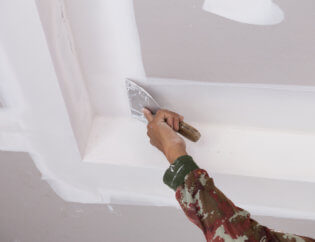
Wall putty should finish at roughly 1.5 mm across two coats, and at that thickness one kilogram covers about 12–15 sq ft on smooth plaster. Published figures range from 10 to 22 sq ft per kg, which sounds like the industry cannot agree. It can. That range is not disagreement — it is four variables nobody is naming.
Name them, and you can work out your number instead of ordering somebody’s average and hoping.
How thick should wall putty be?
Target 1.5 mm total, built as two coats of roughly 0.75 mm. Stay inside 1.0–2.0 mm.
That is not a rule of thumb someone invented. Putty is a polymer-bound finishing material, not a plaster, and it has none of plaster’s tolerance for being laid on thick. Past about 2 mm, three things start happening:
- Shrinkage cracking. The outer surface skins over while the material underneath is still wet. The two dry at different rates, and the difference shows up as fine crazing.
- Debonding. A thicker film weighs more and pulls harder against the bond line as it cures. Eventually it lets go in sheets and takes the paint with it.
- Money burnt. Putty costs more per kg than plaster. Fixing a wavy wall in putty is the most expensive method available.
If the wall is more than a couple of millimetres out of true, correct it in the plaster coat. No thickness of putty makes an uneven wall flat without storing up a failure to pay for later.
Why the published figures disagree
Four variables, in rough order of how much they matter.
Surface roughness
The big one. Smooth, well-finished plaster takes putty evenly. Rough or sandy plaster drinks the first coat filling voids before it starts levelling anything.
On poor plaster, expect coverage to fall by a third or more. This is where site quantities overrun, almost every time.
Number of coats
Coverage figures are usually quoted for two. A three-coat spec does not use 50% more — the third is thin — but it uses meaningfully more. Anything quoted for a single coat is not comparable, and it is where the highest published numbers tend to come from.
Water at mixing
Too much water spreads further and leaves a weaker, dustier film that undermines everything above it. Coverage bought by over-watering is not a saving, it is a defect on deferred payment. Mix to the ratio on the bag.
Applicator skill
A practised hand lays a thin, even coat. An inexperienced crew lays it thicker than it needs to be, and coverage drops accordingly. Real, measurable, and routinely left out of estimates.
What to actually plan on
| Wall condition | Realistic coverage, two coats | Use when |
|---|---|---|
| Smooth, well-finished plaster | 14–16 sq ft/kg | Best case |
| Typical plaster, minor unevenness | 12–14 sq ft/kg | Most jobs |
| Rough, sandy or patchy plaster | 8–11 sq ft/kg | Add contingency |
| Over sound existing paint (acrylic) | Thin skim, varies widely | Estimate from a sample area |
Manufacturer figures at the top of the published range are usually a premium putty on ideal plaster. That is a legitimate number, honestly measured. It is simply not the number most sites will ever see.
Working out your quantity
Step 1 — Measure. Length × height for each wall, added up. Subtract windows and doors only if they are large; small openings are useful slack.
Step 2 — Choose a coverage figure from the table, based on the plaster you have rather than the plaster you were promised.
Step 3 — Divide. Area ÷ coverage = kilograms.
Step 4 — Add 10%. Corners, edges, touch-ups and mixing losses are not optional extras, they are the job.
Worked example
A 12 ft × 15 ft room, 10 ft ceilings, typical plaster:
- Wall area: 2 × (12 + 15) × 10 = 540 sq ft
- Less a door and a window, say 40 sq ft → 500 sq ft
- At 13 sq ft/kg: 500 ÷ 13 = 38.5 kg
- Plus 10%: ≈ 42 kg
Convert that to bags using the pack size of the product you are buying — it is on the bag and on the data sheet. Round up, never down. One spare bag costs a few hundred rupees. The wall from the top of this page costs a day of labour and a wall’s worth of material.
Getting the coverage you paid for
Coverage is settled on site far more than it is settled by the bag. What you control:
- Prepare the surface. Remove loose material, dust and laitance. Putty applied over dust bonds to dust.
- Dampen the wall before cement-based putty. A dry, absorbent wall pulls water out of the mix and kills both workability and bond.
- Mix to the stated ratio, and only mix what can be used inside the working time.
- Two thin coats, never one thick one. Better coverage, better finish, fewer defects.
- Cure it. Cement-based putty needs water curing per the data sheet. On a hot site this is the first thing dropped, and it is the quiet cause of most weak, powdery surfaces.
- Plan the day around whole walls. Where you stop is where the lap mark goes. Finish a wall or start a different one.
For the full application sequence, see the best ways to use wall putty. If the product is not chosen yet, start with which wall putty to use — cement-based and acrylic are not interchangeable, and that choice matters more than the quantity does.
Where these numbers come from
We manufacture wall putty, so the honest disclosure is this: the coverage figure on any bag, ours included, describes good conditions. It is measured on smooth, well-prepared plaster by someone who does this for a living. That is a real number, fairly obtained. It is also the best case, and most sites are not the best case.
The ranges here are drawn from published Indian market figures gathered in August 2026, cross-checked against what actually gets consumed on site. Where our own tested figure appears, it comes from the data sheet, which you can download and check rather than take our word for.
If you are estimating a real job and want a second pair of eyes on the quantity, our technical team will do that with you — send us the areas. We would rather help you order right once than sell you a bag you did not need.
Frequently asked questions
How much wall putty is needed for 100 sq ft? On typical plaster at two coats, roughly 7–8 kg. Smooth plaster, nearer 6.5 kg. Rough plaster, budget 9–12 kg. Add 10% to whichever applies.
How thick should wall putty be? About 1.5 mm total across two coats, kept inside 1.0–2.0 mm. Thicker causes shrinkage cracking and debonding rather than a better finish.
Can I apply wall putty in one coat? Not for a proper finish. The first coat fills, the second levels. A single coat leaves an uneven, absorbent surface that shows straight through the paint.
Does coverage change between brands? Somewhat — but far less than the wall does. Rough plaster will cost you more material with any brand than smooth plaster will with the cheapest one.
What happens if I run out mid-wall? Where the work stops, a lap mark forms — a visible line of different sheen that usually only appears once the paint dries. It cannot be patched out; the wall has to be sanded back and redone. This is why you round the order up.
Should I water-cure wall putty? Cement-based, yes — follow the data sheet. Acrylic putty air-dries and needs no curing.