Best Wall Putty in India (2026): How to Choose, Not Just What to Buy
Cement-based or acrylic? Interior or exterior? Best Wall Putty in India 2026. A decision framework for choosing wall putty in India, with coverage maths and the mistakes that…
The flats were handed over in March. By October the west-facing walls had started to lift.
Not flake — lift, in sheets, with a thin white layer still stuck to the back of the paint.
The owners called the builder. The builder called the painter. The painter, reasonably enough, pointed out that his paint had held perfectly well on every other elevation in the block, and suggested the problem was underneath it.
He was right. Underneath was an acrylic putty, on an exterior wall, and the first monsoon had found it.
Somebody now had to strip and redo eleven walls. Not repaint — strip, because putty that has let go takes the finish with it and there is nothing to paint onto. The material cost of that mistake was trivial. The labour, the scaffolding and the argument about who paid were not.
And all of it traces back to a decision made in roughly four seconds at a counter, months earlier, by someone who had two products in front of them and no particular reason to prefer one.
So let us take longer than four seconds.
If the wall is bare plaster, concrete, blockwork, or faces the weather, you want a white-cement-based putty. If you are skimming over interior paint that is still sound, you want acrylic. That single choice decides whether this finish gets repainted in a few years or stripped back to the wall.
Everything below is how to know which one you are standing in front of.
Start with the mark, not the brand
Before price, before anyone’s recommendation, before the top-ten list: India has a published standard for this, and knowing the number changes the conversation.
IS 17545:2021 — White Cement Based Wall Putty. It sets out what the product has to actually do: tensile adhesion strength, setting time, consistency, water retentivity, polymer content, limits on lead. BIS certification against it is mandatory for wall putty manufacturers in India.
Which means the ISI mark on a bag is not a sticker. It means the product was tested against a published specification instead of a marketing sentence.
You will notice almost none of the “top 10 wall putty brands” articles mention this. It is the most useful thing on this page, because it lets you check any product yourself — ours included — without trusting a word of what anyone writes about it.
Two things worth knowing. The older IS 14817 (premixed polymer-modified mortar) is still quoted by some suppliers; it is not the current specification for white-cement wall putty. And IS 17545 covers white-cement-based putty only — an acrylic putty is a different category and will not carry it, which is not a failing, just a different product.
Ask for the certification and the data sheet. A supplier who can produce neither has answered your question.
Four questions that settle it
Is the wall inside or outside?
Exterior walls take rain, thermal movement and UV. They need a cement-based putty with stated water resistance. Full stop.
Acrylic putty on an exterior wall is the most common specification error we see in Indian residential work, and it is patient. It looks entirely fine through the dry months. Then water gets behind it, and you get October.
What is underneath?
| Substrate | Use | Why |
|---|---|---|
| Fresh cement plaster | White-cement-based | Chemically compatible; bonds as the surface cures |
| Concrete / RCC | White-cement-based | Needs the alkali tolerance a cement system has |
| Sound existing paint | Acrylic | Bonds to a film where cement putty simply cannot |
| Gypsum plaster | Acrylic, or a putty rated for gypsum | Cement putty over gypsum risks a weak, dusty interface |
| AAC blockwork | White-cement-based, over a base coat | Very absorbent — without the base coat the putty dries before it bonds |
How wet does it get?
Bathrooms, kitchens, parapets, weather-side walls: water resistance has to be a stated property, not an optimistic assumption.
And if the wall has ever shown damp, fix the damp first. Putty is a levelling material, not a waterproofing one. Nothing you skim on will hold a finish over a wall that is still taking on water — it will just fail later, and more expensively, with a fresh coat of paint on top of it.
Who is actually holding the trowel?
A trained applicator will get a fine finish out of cement-based putty. A crew working fast on a tight programme will get a more consistent result from a ready-mixed acrylic on interiors, purely because there is less to get wrong before it reaches the wall.
That is not a criticism of anyone. It is an honest read of where site risk actually lives, and pretending otherwise helps nobody.
Cement-based or acrylic: where the line falls
Asserted everywhere, quantified almost nowhere.
| White-cement-based | Acrylic | |
|---|---|---|
| Form | Powder, mixed on site | Ready-mixed paste |
| Exterior use | Yes | No |
| Water resistance | Good, improves as it cures | Limited |
| Bond to bare plaster or concrete | Excellent | Poor to moderate |
| Bond over existing paint | Poor | Excellent |
| Thickness, two coats | 1.0–1.5 mm | Thin skim only |
| Curing | Needs water curing | Air-dries |
| Site risk | Mixing and curing must be controlled | Very low |
| Cost per sq ft | Lower | Higher |
| Covered by IS 17545 | Yes | No — different category |
The rule that falls out of it: bare masonry and anything outdoors, cement-based. Over sound interior paint, acrylic. The genuine overlap between them is far narrower than the shelf suggests.
What separates a good putty from a cheap one
Once the type is settled, the differences come down to a handful of properties. These are the ones to ask about.
Whiteness and opacity. A whiter putty means the topcoat covers in fewer coats — a saving on paint, which is the more expensive material. This is where cheap putty quietly costs more.
Tensile adhesion strength. The number that predicts whether the system stays on the wall. IS 17545 specifies how it is tested, so ask for the tested value, not an adjective.
Coverage per kg. Published figures run from roughly 10 to 22 sq ft per kg — a 2.2× spread that is mostly surface condition and coats, not brand. A per-kg price therefore tells you very little; work in cost per sq ft finished. The maths is in wall putty coverage and thickness.
Sanding behaviour. A putty that sands easily saves labour hours. A putty that sands too easily is underbound and will powder under the paint.
Water and alkali resistance. Non-negotiable outdoors and in wet areas.
Five mistakes that cause rework
Industry guidance on putty failure is blunt about where fault usually lies: most cracking traces to construction error rather than weather, and the best putty on the market will still fail if it is badly installed. That matches what we see on site.
- Acrylic on an exterior wall. The one at the top of this page. Most common, most expensive, entirely avoidable.
- Putty over damp. Fix the moisture source first, or you are just decorating a problem.
- Too thick. Putty is not plaster. Building it up to correct an uneven wall causes shrinkage cracking, because the surface skins over while the material underneath is still wet. Correct the level in the plaster coat.
- Skipping the cure. Cement-based putty needs water curing. On a hot site this is the first step dropped, and it is the quiet cause of most dusty, weak surfaces.
- Guessing at the primer. Some systems need one, some do not. The data sheet says which. Guessing costs a coat of paint.
Where Zeorich fits
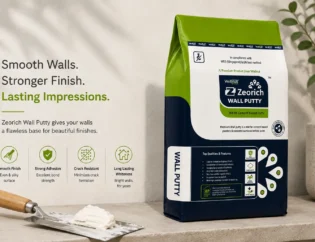
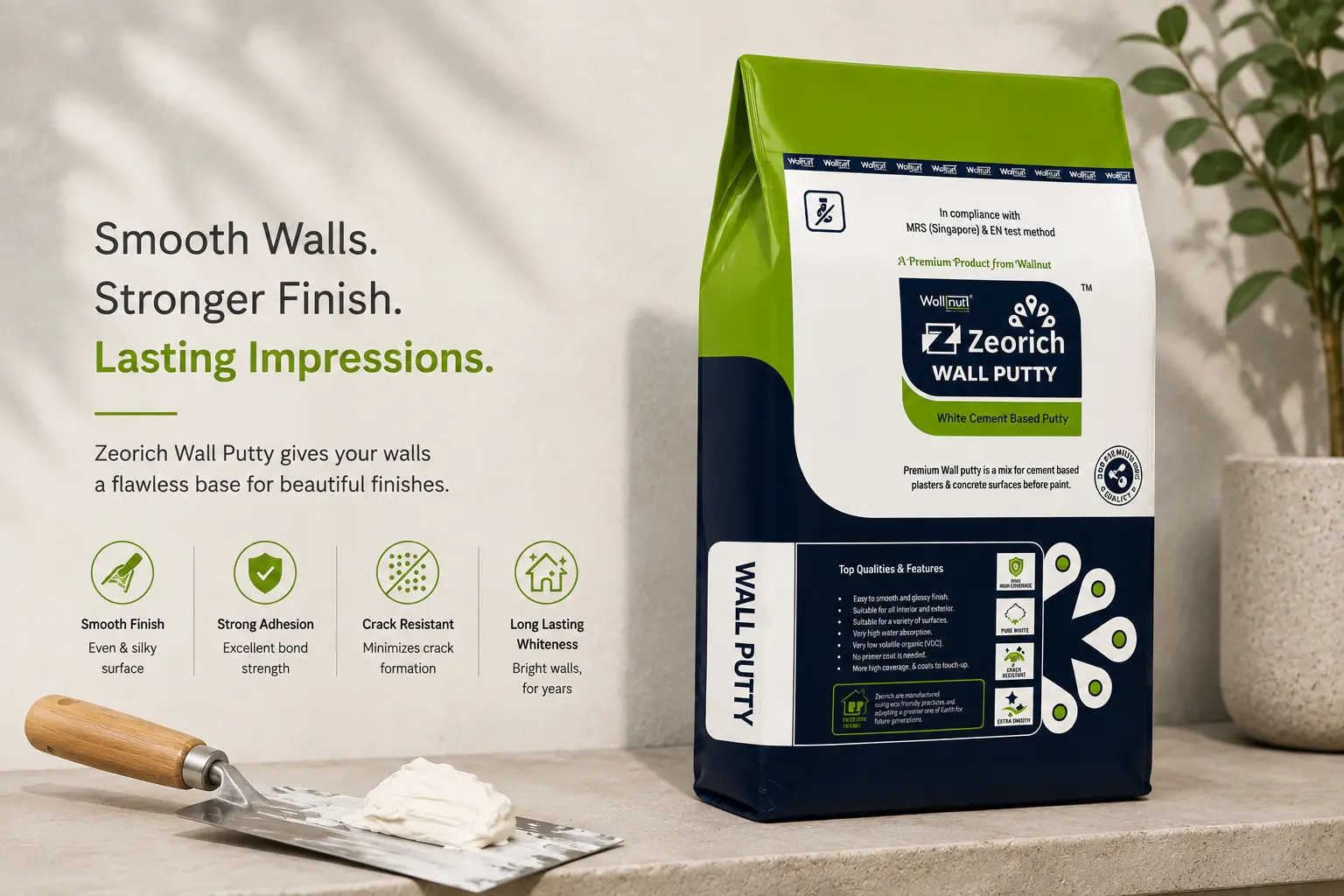
We make Zeorich Wall Putty, a white-cement-based putty for interior and exterior use.
Coverage, pack sizes and tested adhesion values live on the data sheet rather than in this paragraph, so that what you read is the current tested figure and not a number that quietly went stale in a blog post. Download it and hold it against whatever else you are considering — starting with whether that product carries IS 17545 at all.
And the boundary, stated plainly: because Zeorich is cement-based it belongs in the left column of that table. Bare plaster, concrete, AAC, exteriors, wet areas. If you are skimming over sound interior paint, an acrylic putty is the better technical choice, and it is not one of ours.
For project quantities or trade enquiries, talk to our technical team.
Back to those eleven walls
Nothing about that job was unusual. The plaster was fine. The paint was fine. The applicator was competent. The building was well built.
One product was wrong for one exposure, and nobody caught it, because the question never got asked out loud.
The whole of this page is that question, asked out loud: what is the wall, where is it, how wet does it get, and who is applying it. Four answers, thirty seconds, and a certification number you can check.
That is the entire difference between a finish that lasts and a conversation in October about who pays for scaffolding.
Why trust this page
We manufacture construction chemicals, and a good part of our technical team’s week is spent on sites looking at surfaces that did not work out. It is a useful vantage point — failures teach far more than successes, and the same few causes keep coming back.
It also means we sell into this category, and you should read accordingly. So here is the test of whether this was worth your time: we have pointed you at a public standard you can audit any manufacturer against, including us, and we have told you twice where a product we do not make is the better choice.
Specifying the wrong material to win a bag sale costs everyone more in the end. We would rather you got the wall right.
Frequently asked questions
Is wall putty necessary, or can I paint straight onto plaster? You can, but you will use noticeably more paint and the finish will show every imperfection. Putty levels the wall and gives the topcoat a uniform, low-absorption base. On smooth, well-finished plaster with a premium paint, skipping it is defensible. On typical Indian plaster it costs more than it saves.
Is wall putty the same as white cement? No. White cement is one ingredient. Wall putty is white cement blended with polymers and mineral fillers that give it adhesion, workability and flexibility. Plain white cement on a wall is brittle and bonds poorly.
What is the IS standard for wall putty in India? IS 17545:2021, White Cement Based Wall Putty. It covers tensile adhesion strength, setting time, consistency, water retentivity, polymer content and lead limits, and BIS certification against it is mandatory for manufacturers. The older IS 14817 is still sometimes quoted but is not the current specification.
How many coats of putty do I need? Two, in almost all cases. The first fills, the second finishes, and total thickness should stay near 1.5 mm. Needing a third usually means the plaster underneath should have been corrected first.
Can I apply putty over old paint? Only with an acrylic putty, and only if the paint is sound and well bonded. If it is flaking or chalking it has to come off. Putty will not rescue a failing paint film — it will fail along with it.
Which putty is best for exterior walls? A white-cement-based putty carrying IS 17545 certification, with stated water and alkali resistance. Acrylic putty is not suitable for exterior exposure in Indian conditions.